Call for Papers
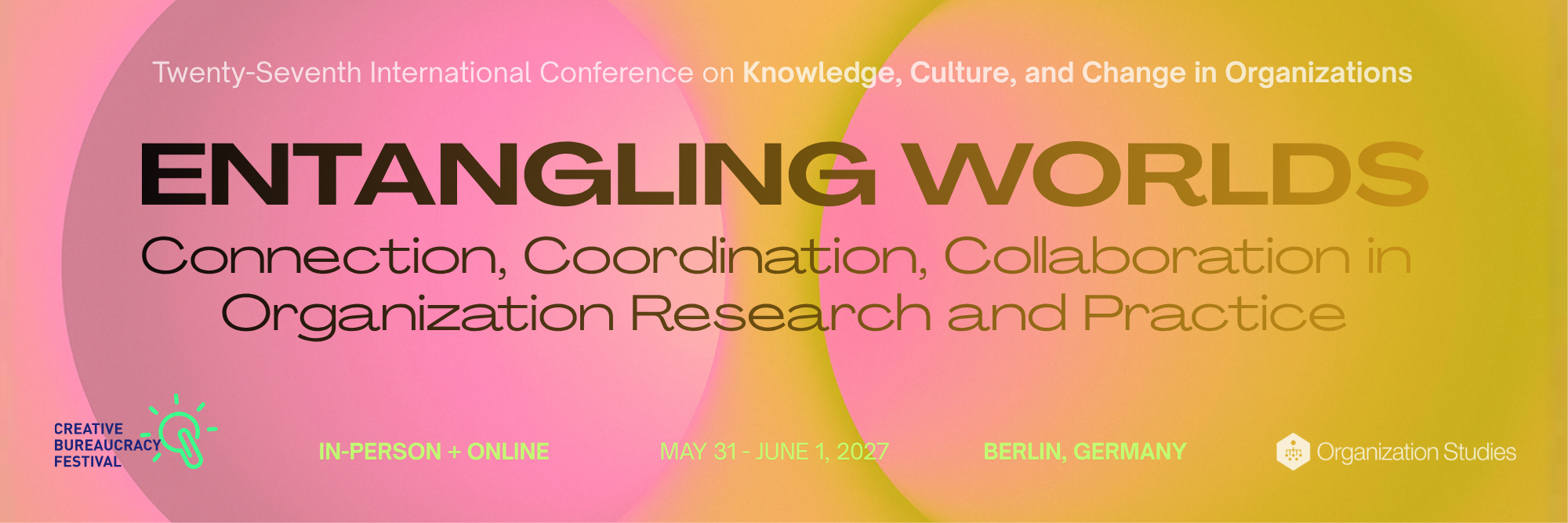
We invite you to join us for the Twenty-Seventh International Conference on Knowledge, Culture, and Change in Organizations, the annual meeting of the Organization Studies Research Network, taking place in Berlin, Germany and online, held alongside the Creative Bureaucracy Festival.
The Organization Studies Research Network is an established international meeting place for researchers, practitioners, policymakers, public-sector leaders, educators, consultants, designers, and organizational change-makers working across the study and practice of organizations. The conference welcomes proposals that examine organizations not only as formal structures, but as living systems of knowledge, culture, coordination, power, responsibility, and change.
Today’s organizations are operating in conditions of deep interdependence. Workplaces, institutions, publics, technologies, communities, and environments are increasingly entangled, requiring new ways to understand connection, coordination, and collaboration. Key issues include organizational change, leadership, public administration, workplace culture, knowledge systems, digital transformation, governance, institutional trust, innovation, sustainability, equity, bureaucracy, and the future of work. We welcome interdisciplinary proposals that engage these questions through research, practice, policy, organizational learning, and applied inquiry.
Special Focus + Themes
The 2027 special focus, Entangling Worlds: Connection, Coordination, Collaboration in Organization Research and Practice, invites participants to examine how organizations operate across overlapping social, technological, institutional, and ecological worlds.
Organizations today rarely act alone. They work through networks, partnerships, platforms, supply chains, public systems, communities, professions, and cross-sector collaborations. This creates new possibilities for shared knowledge and collective action, but also new challenges of accountability, coordination, legitimacy, communication, and care.
This special focus asks how organizations can respond to complex problems that no single institution can solve by itself. How do organizations build trust across difference? How do they coordinate across public, private, nonprofit, and community sectors? How do bureaucracies become more creative, responsive, and humane? How do cultures of work change when knowledge, labor, technology, and responsibility are distributed across many actors and places?
We welcome proposals that address organizations as sites of practice and as systems of relation, shaped by people, infrastructures, technologies, cultures, policies, environments, and histories.
Themes
- Theme 1: Organizational Cultures, Knowledge, and Change: exploring how organizations create, share, manage, and transform knowledge, culture, identity, leadership, learning, communication, and institutional memory.
- Theme 2: Coordination, Governance, and Public Purpose: examining decision-making, public administration, bureaucracy, policy implementation, institutional trust, accountability, regulation, and the coordination of complex systems.
- Theme 3: Work, Technology, and Organizational Futures: considering digital transformation, AI, platforms, hybrid work, automation, workplace design, labor, skills, innovation, and the changing conditions of organizational life.
- Theme 4: Collaboration, Equity, and Sustainable Systems: addressing cross-sector collaboration, organizational responsibility, inclusion, equity, sustainability, community partnerships, ethical practice, and collective responses to shared social and environmental challenges.
Knowledge Experience and Format
The conference is organized as a hybrid knowledge experience, integrating in-person and online participation within a unified scholarly environment.
For in-person delegates in Berlin, the conference is designed as a human-scale gathering shaped by conversation, shared inquiry, and connection to the city’s wider ecosystem of institutional, cultural, and civic innovation. Held alongside the Creative Bureaucracy Festival, the conference creates opportunities to connect organization research with public-sector creativity, policy practice, administrative imagination, and real-world experiments in institutional change.
For online delegates, the conference is more than a remote viewing option. Accepted proposals become Presentation Pages where presenters share abstracts, media, and supporting materials. Delegates participate through live online sessions, asynchronous engagement, and discussion spaces that remain available before, during, and after the event.
Across both formats, the emphasis is on reciprocal exchange rather than one-way presentation. Whether joining in Berlin or online, participants are part of a shared knowledge environment where ideas can be presented, discussed, revisited, and developed into future collaborations, publications, policy conversations, organizational initiatives, and communities of practice.
Publication Pathways
Presenters are invited to further develop their conference work for possible publication in the peer-reviewed journals of the Organization Studies Research Network:
- The International Journal of Knowledge, Culture, and Change Management: Annual Review
- The International Journal of Knowledge, Culture, and Change Management: Organizational Cultures
- The International Journal of Knowledge, Culture, and Change Management: Organizational Learning
- The International Journal of Knowledge, Culture, and Change Management: Organizational Change
Join Us
We warmly invite you to submit a proposal and join us, either in Berlin or online, for the Twenty-Seventh International Conference on Knowledge, Culture, and Change in Organizations.
Together, we will examine how organizations are being reshaped by entangled worlds of knowledge, culture, technology, policy, labor, and public responsibility, and how more collaborative and responsive forms of organizational life can be imagined and built.
Sincerely,
Charles Landry, Research Network Chair, Creative Bureaucracy & Civic City in a Nomadic World, United Kingdom
Anke Gruendel, Research Network Chair, Leuphana University Lüneburg, Germany
Phillip Kalantzis-Cope, Chief Social Scientist, Common Ground Research Networks, United States of America